Calming Techniques for Anxiety: Proven Methods for 2026
Anxiety doesn't arrive with a warning. It shows up during morning meetings, while waiting in line at the grocery store, or in the middle of the night when your mind won't stop racing. The physical sensations-tight chest, racing heart, shallow breathing-can feel overwhelming and uncontrollable. Yet evidence-based calming techniques for anxiety can help you regain your sense of balance and return to the present moment, even when your nervous system feels hijacked by worry and fear.
Understanding How Anxiety Affects Your Body
When anxiety strikes, your body enters a state of high alert. Your sympathetic nervous system activates the fight-or-flight response, releasing stress hormones like cortisol and adrenaline.
This biological reaction served our ancestors well when facing immediate physical danger. In modern life, however, our bodies often respond to psychological stressors with the same intensity.
Physical symptoms of anxiety include:
- Rapid heartbeat and elevated blood pressure
- Shallow, quick breathing or hyperventilation
- Muscle tension, particularly in the shoulders and jaw
- Digestive distress and nausea
- Sweating and trembling
- Dizziness or lightheadedness
Recognizing these symptoms as anxiety rather than a medical emergency represents the first step toward managing them effectively. Grounding techniques help interrupt this cascade of physical responses by engaging your parasympathetic nervous system, which promotes calm and restoration.

Breathing Exercises That Reset Your Nervous System
Controlled breathing stands among the most powerful calming techniques for anxiety because it directly influences your autonomic nervous system. Unlike your heartbeat or digestion, breathing bridges the conscious and unconscious, giving you direct access to physiological calm.
Box Breathing for Immediate Relief
Box breathing, also known as square breathing, creates equal intervals of inhalation, holding, exhalation, and holding again. This technique has gained popularity among Navy SEALs and first responders who need to manage stress in high-pressure situations.
Practice box breathing with these steps:
- Inhale slowly through your nose for four counts
- Hold your breath for four counts
- Exhale completely through your mouth for four counts
- Hold empty for four counts
- Repeat for four to eight cycles
The regularity and predictability of this pattern signal safety to your nervous system. Research on anxiety management confirms that consistent breathing practices reduce cortisol levels and activate the vagus nerve, which controls the relaxation response.
The Physiological Sigh Technique
Stanford neuroscientist Andrew Huberman has popularized the physiological sigh, a breathing pattern that quickly reduces stress. This method involves two inhales through the nose followed by a long exhale through the mouth.
The double inhale re-inflates collapsed alveoli in your lungs, while the extended exhale removes excess carbon dioxide. Mindfulness practices for anxiety highlight this as one of the fastest ways to shift from an anxious state to calm awareness.
Grounding Techniques That Anchor You to the Present
When anxiety pulls you into catastrophic future thinking, grounding exercises redirect your attention to immediate sensory experiences. These calming techniques for anxiety work by occupying the parts of your brain responsible for worry with concrete, present-moment observations.
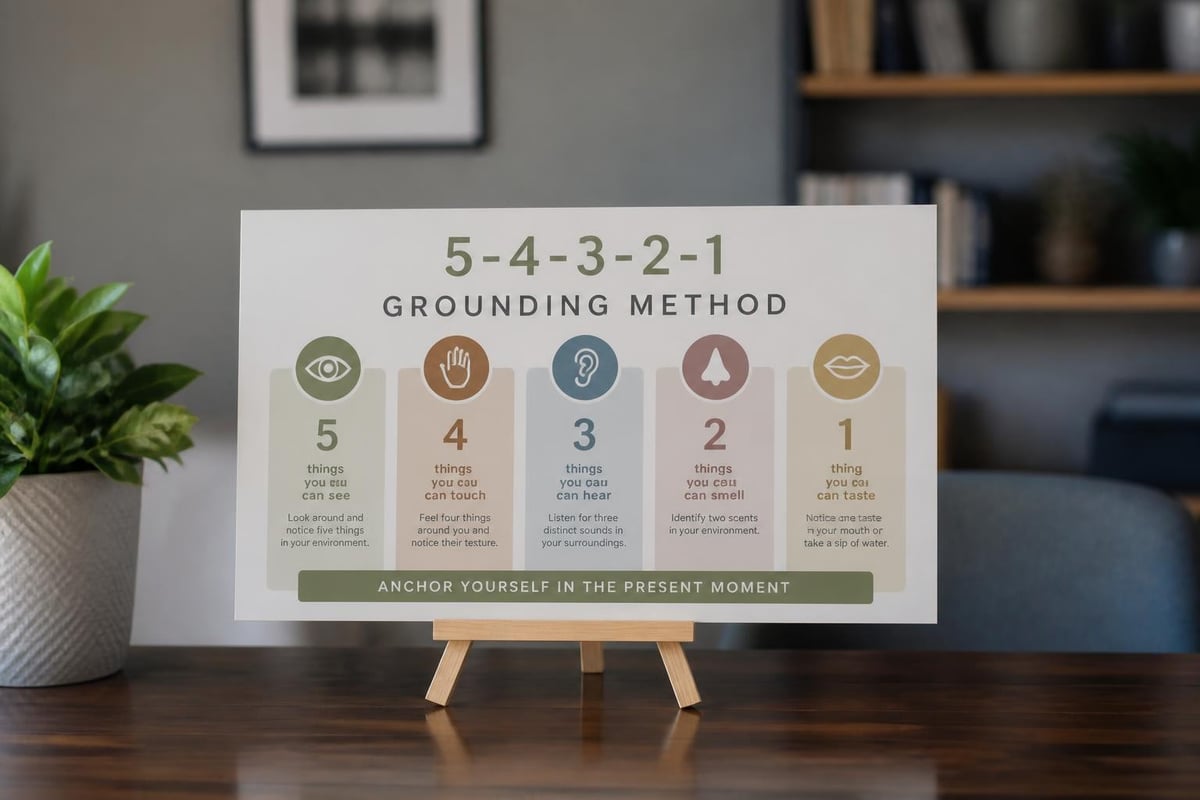
The 5-4-3-2-1 Sensory Method
This widely-used technique engages all five senses systematically, creating a comprehensive anchor to the present moment. Evidence-based grounding practices demonstrate its effectiveness across diverse anxiety presentations.
| Sense | Action | Example |
|---|---|---|
| Sight | Name 5 things you see | Blue coffee mug, ceiling fan, green plant, laptop, pen |
| Touch | Notice 4 textures | Smooth desk surface, soft sweater fabric, cool glass, rough paper |
| Sound | Identify 3 sounds | Air conditioning hum, distant traffic, keyboard clicking |
| Smell | Recognize 2 scents | Coffee aroma, fresh air from window |
| Taste | Acknowledge 1 taste | Mint from earlier toothpaste, lingering tea flavor |
This structured approach prevents your mind from wandering back into anxious thought patterns. The specificity required to complete each step demands attention that would otherwise fuel worry cycles.
Physical Grounding Through Touch
Tactile grounding provides immediate sensory feedback that contradicts the abstract nature of anxious thoughts. Recent research on tactile comfort shows how physical touch interactions can lower heart rates and provide measurable anxiety relief.
Effective physical grounding methods include:
- Holding an ice cube until it melts completely
- Pressing your feet firmly into the floor
- Running cold water over your hands
- Squeezing a stress ball or textured object
- Wrapping yourself in a weighted blanket
The concrete, undeniable sensation of physical touch creates an experiential argument against anxious predictions. You cannot simultaneously notice the exact temperature of cold water and catastrophize about future events.
Progressive Muscle Relaxation for Physical Tension
Progressive muscle relaxation (PMR) addresses the physical manifestations of anxiety by systematically tensing and releasing muscle groups. This technique, developed by physician Edmund Jacobson in the 1920s, remains a cornerstone among calming techniques for anxiety.
The practice works on two levels. First, deliberately tensing muscles before releasing them creates a more profound relaxation than simply trying to relax. Second, the focused attention required prevents rumination and worry.
Standard PMR Sequence
Begin in a comfortable seated or lying position. Work through each muscle group, tensing for five seconds and releasing for ten seconds while noticing the difference between tension and relaxation.
- Hands and forearms: Make tight fists
- Upper arms: Bend elbows and flex biceps
- Shoulders: Raise shoulders toward ears
- Face: Scrunch facial muscles together
- [Chest and abdomen: Take a deep breath and tighten core
- Legs and feet: Point toes and tighten leg muscles
Self-regulation techniques like PMR have proven particularly effective for office workers and others who hold stress physically in their bodies. The entire sequence takes approximately 10-15 minutes and can be shortened to target specific areas where you hold tension.
Mindfulness and Present-Moment Awareness
Mindfulness represents a fundamental shift in how you relate to anxious thoughts rather than a technique to eliminate them. Instead of fighting anxiety or trying to suppress worries, mindfulness teaches you to observe mental content without judgment or engagement.
This approach aligns with the understanding that anxiety thrives on resistance. When you notice an anxious thought and label it simply as "thinking" rather than truth, you create distance from its emotional impact.
Active Noticing Practice
Active noticing, sometimes called mindful observation, involves deliberately focusing on a single object or experience with complete attention. This practice calms the nervous system by giving your mind a specific, manageable task.
Choose one focus point:
- Watch clouds move across the sky
- Observe a candle flame without blinking
- Listen to a single instrument in a piece of music
- Feel the texture of fabric between your fingers
- Follow the complete arc of each breath
The goal isn't to empty your mind but to notice when attention wanders and gently return it to your chosen focus. Each return strengthens your ability to redirect attention away from anxious thoughts.
At My Calm Reset, we offer downloadable guides and simple routines specifically designed to help you build these mindfulness practices into your daily life, creating sustainable habits that support long-term anxiety management.

Movement-Based Calming Strategies
Physical activity serves as one of the most underutilized calming techniques for anxiety, yet coping strategies for anxiety consistently emphasize movement's powerful anxiety-reducing effects. Exercise metabolizes stress hormones, increases endorphins, and provides a healthy outlet for nervous energy.
Immediate Movement Options
You don't need a gym membership or specialized equipment to use movement as an anxiety management tool. Simple activities can shift your physiological state within minutes.
- Walking: A brisk 10-minute walk changes your environment, engages large muscle groups, and provides rhythm that can be meditative
- Stretching: Gentle stretches release physical tension and bring attention to body sensations rather than worried thoughts
- Dancing: Moving to music combines rhythm, physical exertion, and potential joy or playfulness
- Yoga poses: Child's pose, forward fold, and legs-up-the-wall specifically activate the parasympathetic nervous system
The key is choosing movement that feels accessible in the moment. When anxiety strikes, the threshold for starting needs to be low. A simple five-minute reset combining breathing and gentle movement can create significant shifts.
Cognitive Techniques for Anxious Thinking Patterns
While physical calming techniques for anxiety address bodily symptoms, cognitive approaches work with the thought patterns that fuel worry. These methods don't require you to "think positive" but rather to examine thoughts with curiosity and skepticism.
Thought Recording and Challenging
Anxious thoughts often masquerade as facts. Writing them down exposes their speculative nature and creates opportunity for evaluation.
| Anxious Thought | Evidence For | Evidence Against | Balanced Perspective |
|---|---|---|---|
| "I'll mess up the presentation" | I'm nervous, made one mistake in practice | I've prepared thoroughly, past presentations went well | I'm well-prepared and some nervousness is normal |
| "Everyone thinks I'm incompetent" | Someone didn't respond to my email | I received positive feedback last week | One non-response doesn't indicate others' opinions |
| "Something terrible will happen" | I feel anxious | Nothing specific has occurred | Anxiety creates false alarms; I'm safe right now |
This structured examination reveals how anxiety generates convincing narratives from minimal evidence. The balanced perspective acknowledges reality without accepting anxiety's exaggerations.
Creating Your Personal Anxiety Toolkit
No single technique works for everyone or every situation. Building a personalized collection of calming techniques for anxiety ensures you have options regardless of where you are or what resources are available.
Toolkit Categories
Quick techniques (under 2 minutes):
- Physiological sigh (three cycles)
- Cold water on wrists
- 5-4-3-2-1 grounding
- Affirmation statements
Medium practices (5-10 minutes):
- Box breathing sequence
- Brief walk or stretching
- Progressive muscle relaxation (abbreviated)
- Mindful observation exercise
Deeper interventions (15+ minutes):
- Full progressive muscle relaxation
- Extended mindfulness practice
- Journaling session
- Calm morning routine when starting the day anxious
Consider creating a physical or digital reminder of your toolkit. When anxiety peaks, decision-making becomes difficult. Having predetermined options eliminates the need to remember what helps in the moment.
Environmental Modifications That Support Calm
Beyond active techniques, certain environmental changes create conditions that reduce anxiety frequency and intensity. These modifications work passively in the background, supporting your nervous system's baseline regulation.
Creating Calming Spaces
Designate a specific area in your home as a calm zone. This space becomes associated with relaxation through repeated use, eventually triggering calm responses simply by being there.
Elements that enhance calming spaces:
- Soft, warm lighting instead of harsh overhead lights
- Comfortable seating that supports good posture
- Minimal visual clutter and organized surroundings
- Natural elements like plants or a small water feature
- Textures that feel pleasant to touch
The importance of rest as a skill extends to creating environments that facilitate genuine restoration rather than just distraction from anxiety.
Managing Digital Overwhelm
Information overload and constant connectivity significantly contribute to modern anxiety. Setting digital boundaries represents a preventive approach to anxiety management.
Practical digital modifications include:
- Disabling non-essential notifications
- Establishing phone-free zones in your home
- Using grayscale mode to reduce device appeal
- Setting specific times for checking email and social media
- Creating a bedtime routine that excludes screens for 30-60 minutes
These boundaries reduce the constant low-level stimulation that keeps your nervous system in a state of vigilance.
Integrating Techniques Into Daily Routines
Calming techniques for anxiety work best when practiced regularly rather than only during acute episodes. Consistent practice strengthens your nervous system's resilience and makes techniques more accessible when needed urgently.
Morning Anxiety Prevention
Starting your day with intentional practices sets a calmer baseline. Even five minutes of structured morning routine can influence your entire day's trajectory.
- Begin with breathing: Three minutes of box breathing before getting out of bed
- Move your body: Gentle stretching or brief yoga sequence
- Set an intention: One word or phrase that represents how you want to feel
- Limit information intake: Delay checking news or email for the first hour
When you address a racing mind early in the day, you prevent the accumulation of anxious momentum.
Evening Wind-Down Protocol
Creating separation between your active day and sleep prevents anxiety from following you to bed. A consistent evening routine signals safety and closure to your nervous system.
- Physical transition: Change into comfortable clothing specifically for evening
- Muscle release: Brief progressive muscle relaxation sequence
- Worry containment: Write any lingering concerns in a journal to address tomorrow
- Sensory calming: Warm bath, herbal tea, or gentle music
- Gratitude practice: Notice three neutral or positive things from the day
This structured approach prevents the common pattern of lying awake with anxiety after an overstimulated day.
When to Seek Additional Support
While self-guided calming techniques for anxiety provide significant relief for many people, some situations warrant professional support. Recognizing when anxiety exceeds what self-management can address demonstrates wisdom rather than failure.
Consider professional help if:
- Anxiety interferes with work, relationships, or daily functioning
- Physical symptoms occur frequently or intensely
- Avoidance behaviors limit your life significantly
- Substance use becomes a coping mechanism
- Anxiety persists despite consistent technique practice
Innovations in anxiety treatment, including self-guided virtual reality therapy, continue expanding accessible options. Mental health professionals can also teach you personalized versions of these techniques tailored to your specific anxiety patterns.
Building a Comprehensive Approach
The most effective anxiety management combines multiple elements: regular practice of calming techniques, lifestyle factors like sleep and nutrition, social connection, professional support when needed, and self-compassion throughout the process.
Various methods to manage anxiety and anger work synergistically rather than in isolation. The breathing exercise you practice makes the grounding technique more accessible. The mindfulness you build enhances your ability to recognize when you need movement. Each element strengthens the others.
Measuring Progress and Adjusting Approaches
Anxiety improvement rarely follows a straight line. Tracking your experience helps you identify which calming techniques for anxiety work best for your unique nervous system and circumstances.
Simple Tracking Methods
Anxiety journal entries should include:
- Intensity rating (1-10 scale) before and after using techniques
- Which technique you chose and why
- Environmental factors (sleep quality, stress level, time of day)
- What worked well and what didn't
- Patterns you notice over time
| Date | Trigger | Technique Used | Before Rating | After Rating | Notes |
|---|---|---|---|---|---|
| July 15 | Work deadline | Box breathing | 8 | 4 | Very effective, used 6 cycles |
| July 16 | Social event | 5-4-3-2-1 grounding | 7 | 6 | Helped somewhat, still felt uneasy |
| July 17 | Morning general anxiety | PMR + walk | 6 | 3 | Combination worked better than either alone |
This data reveals your personal patterns. You might discover that certain techniques work better at specific times of day, or that combining approaches yields better results than single techniques.
Building Long-Term Resilience
The ultimate goal extends beyond managing acute anxiety episodes to building a nervous system that recovers quickly and experiences anxiety less frequently. This resilience develops through consistent practice over time.
Regular use of calming techniques for anxiety literally changes your brain structure. Neuroplasticity allows your brain to strengthen neural pathways associated with calm and weaken those associated with anxious reactivity.
Resilience-building practices include:
- Daily five-minute minimum of chosen calming technique
- Weekly reflection on progress and patterns
- Monthly evaluation of which techniques deserve more focus
- Seasonal adjustment of approaches based on life circumstances
- Continuous learning through our blog and other trusted resources
The investment in these practices compounds over time. Techniques that require significant effort initially become automatic responses that activate with minimal conscious thought.
Anxiety may always arise in challenging moments, but it doesn't need to control your life. The calming techniques for anxiety outlined here-from breathing exercises and grounding methods to movement practices and cognitive approaches-provide proven pathways back to balance when worry threatens to overwhelm. Building your personal toolkit takes time and experimentation, yet the investment yields profound returns in your daily sense of peace and capability. My Calm Reset offers ongoing support through calming blogs, simple routines, and downloadable guides designed to help you feel more balanced, grounded, and at peace in everyday life.
Get the free Mini Reset
A short sample of the 7-day guide — a gentle practice you can try today. Enter your email and the download link appears instantly.
Free. No spam. Unsubscribe anytime.
Want more calm in your life?
The Calm Reset guide is a 48-page digital book of rituals, prompts, and practices for a calmer life.
Get the Guide