
Creating a Wellness Blog That Truly Supports Your Readers

Creating a wellness blog in 2026 requires more than just posting inspirational quotes and smoothie recipes. Today's readers are searching for authentic guidance, practical tools, and a genuine sense of connection as they navigate the complexities of modern life. A successful wellness blog serves as a trusted companion, offering resources that help people cultivate balance, manage stress, and build sustainable habits that support their overall well-being. Whether you're just starting or looking to deepen your existing content strategy, understanding what makes a wellness blog truly valuable can transform how you serve your audience.
Understanding Your Wellness Blog's Core Purpose
Every effective wellness blog begins with a clear mission. Your purpose shapes every piece of content you create, from the topics you explore to the tone you use.
Define your unique perspective by identifying what sets your approach apart. Are you focusing on science-backed strategies, holistic practices, or simple daily rituals? Your wellness blog should reflect your authentic voice and expertise while addressing specific challenges your readers face.
Consider these foundational elements:
- Target audience clarity: Who are you serving, and what specific wellness goals do they pursue?
- Content pillars: What core themes will you explore consistently?
- Value proposition: How does your blog improve readers' lives differently than others?
- Authenticity markers: What personal experiences or expertise inform your guidance?
A comprehensive content strategy framework helps ensure your wellness blog maintains consistency while evolving with your audience's needs. Your mission statement should be concise enough to guide daily decisions yet broad enough to allow creative exploration.
Establishing Trust Through Transparency
Readers gravitate toward wellness blogs that acknowledge the messy reality of pursuing health and balance. Share both successes and setbacks, research-backed information alongside personal insights, and practical solutions that account for real-life constraints.
Transparency builds credibility. When you discuss wellness practices, be honest about what works, what requires adaptation, and what might not suit everyone.

Creating Content That Resonates and Supports
The most impactful wellness blog content meets readers where they are while gently guiding them toward where they want to be. Starting a wellness blog involves strategic choices about content types, publishing frequency, and reader engagement.
Diversifying Your Content Formats
Different readers consume information differently. Some prefer step-by-step guides, while others connect with personal stories or quick tips.
| Content Type | Purpose | Best For |
|---|---|---|
| How-to Guides | Teach specific skills or practices | Readers seeking actionable steps |
| Personal Essays | Build connection and relatability | Audience craving authenticity |
| Resource Roundups | Provide curated tools and references | Time-conscious readers |
| Routine Breakdowns | Share practical daily structures | Those building new habits |
| Q&A Posts | Address specific reader questions | Community engagement |
Mix these formats throughout your editorial calendar to maintain variety and serve different learning preferences. Your wellness blog becomes more valuable when it offers multiple entry points for engagement.
Developing Practical, Accessible Content
Wellness shouldn't feel exclusive or overwhelming. The best content simplifies complex topics without oversimplifying the nuances.
When writing about meditation, for example, don't just explain the benefits. Provide a realistic approach for someone who's never meditated, acknowledge common obstacles like restlessness or time constraints, and offer modified versions for different situations.
Consider these content principles:
- Start with the reader's current reality, not an idealized version
- Break down practices into manageable steps
- Acknowledge barriers and offer solutions
- Provide options for different schedules, budgets, and preferences
- Follow up with ongoing support content
Platforms like My Calm Reset demonstrate how wellness blogs can combine thoughtful content with practical downloadable resources, giving readers tools they can implement immediately rather than just inspiration to think about later.

Building a Content Strategy That Sustains
A wellness blog requires strategic planning to maintain consistency without burning out. Your content strategy should support both your audience's needs and your own sustainability as a creator.
Planning Your Editorial Calendar
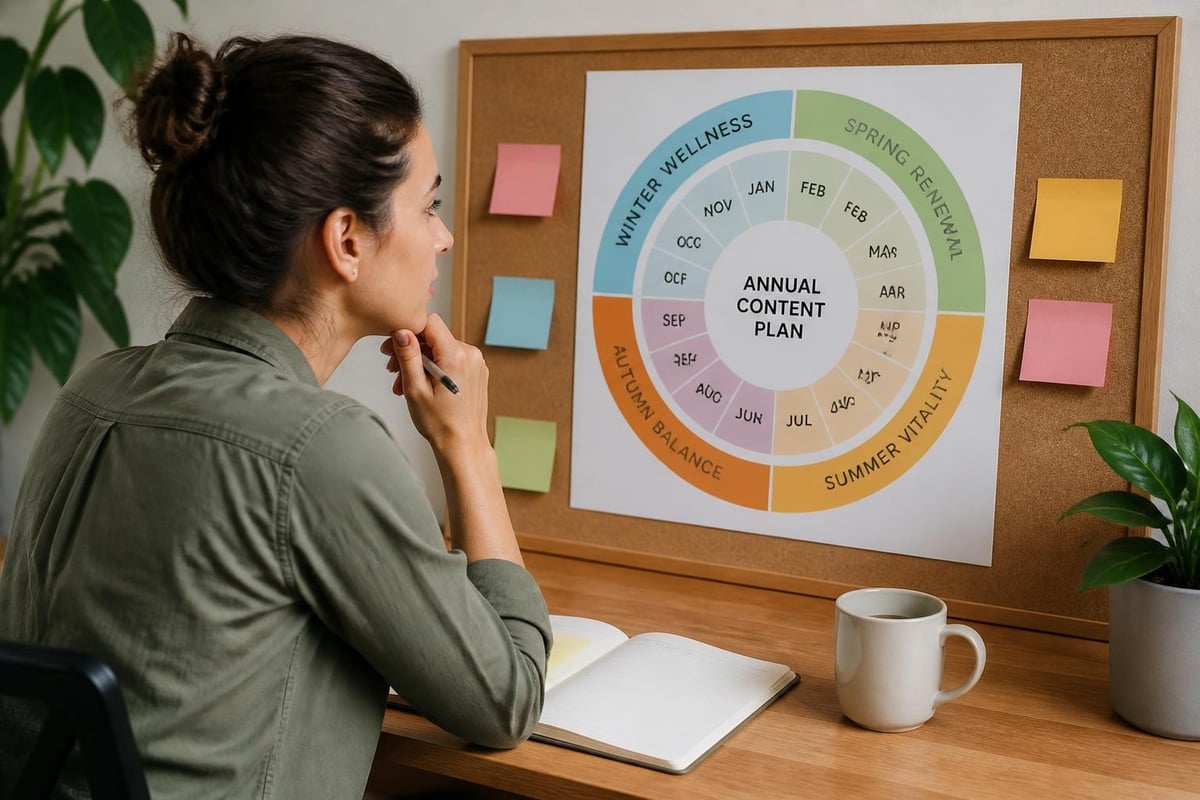
Map content across multiple dimensions to ensure comprehensive coverage while maintaining focus. Plan monthly themes that explore different aspects of wellness, then develop specific posts that examine various angles of each theme.
For instance, a month focused on stress management might include:
- Understanding stress responses in the body
- Five-minute grounding techniques for busy schedules
- Creating an evening routine that supports better sleep
- Nutritional strategies that support nervous system health
- Setting boundaries that protect your energy
This approach provides depth while keeping content cohesive. Your wellness blog becomes a reliable resource rather than a random collection of posts.
Incorporating Seasonal Relevance
Align your wellness blog content with the natural rhythms your readers experience throughout the year. Spring might focus on renewal and energy, while winter content could emphasize rest and reflection.
Seasonal content ideas:
- January: Sustainable goal-setting and fresh starts
- April: Spring cleaning for mental and physical spaces
- July: Maintaining wellness during summer disruptions
- October: Transitioning routines as seasons change
Drawing from diverse wellness content ideas ensures your blog remains fresh and relevant throughout the year while addressing timely reader concerns.
Engaging Your Wellness Blog Community
A wellness blog thrives when it fosters genuine community rather than one-way communication. Your readers are your greatest resource for understanding what content truly helps.
Encouraging Reader Interaction
Create opportunities for dialogue throughout your content. End posts with thoughtful questions that invite reflection and sharing. Respond to comments with substance, not just acknowledgment. Share reader stories and experiences (with permission) to demonstrate real-world application of your guidance.
Community-building strategies include:
- Monthly challenges that readers can participate in together
- Reader survey posts that shape future content
- Comment spotlights that honor reader contributions
- Live Q&A sessions or office hours
- Private community spaces for deeper connection
The most successful wellness blog platforms recognize that healing and growth happen in community, not isolation.
Maintaining Consistent Publishing Rhythm
Consistency matters more than frequency. Whether you publish daily, weekly, or bi-weekly, maintain a reliable schedule so readers know when to expect new content.
| Publishing Frequency | Pros | Considerations |
|---|---|---|
| Daily | Maximum engagement potential | High content demands |
| 3x Weekly | Strong presence without overwhelm | Requires planning and batch creation |
| Weekly | Sustainable for most creators | Needs highly valuable content |
| Bi-weekly | Allows deep research and quality | Requires strong email strategy |
Choose a rhythm you can maintain during both inspired and challenging periods. Your wellness blog serves readers best when it's dependable.
Expanding Content Depth and Variety
As your wellness blog matures, deepen your content while maintaining accessibility. Explore topics from multiple angles and acknowledge the interconnected nature of wellness.
Covering the Wellness Spectrum
True wellness extends beyond green smoothies and yoga poses. Comprehensive wellness topics span physical health, emotional well-being, social connection, intellectual growth, spiritual exploration, purposeful work, and financial peace.
Address these dimensions through your wellness blog by:
- Exploring how physical movement affects mental clarity
- Discussing financial stress as a wellness concern
- Examining relationship health alongside individual practices
- Connecting creative expression to emotional processing
- Investigating how environment shapes well-being
This holistic approach recognizes that readers are whole people with interconnected needs.
Developing Series and Deep Dives
While standalone posts serve immediate needs, series create anticipation and allow thorough exploration of complex topics. A three-part series on building morning routines might cover the science of circadian rhythms, common obstacles and solutions, and personalizing practices for different lifestyles.
Series benefits for your wellness blog:
- Builds returning readership and loyalty
- Allows comprehensive topic coverage
- Creates natural opportunities for internal linking
- Demonstrates expertise through depth
- Provides content for email sequences
Long-form guides and series posts also perform well in search results, bringing new readers to your wellness blog through organic discovery.
Integrating Practical Tools and Resources
Modern readers appreciate content that goes beyond information to provide actual tools. Your wellness blog becomes exponentially more valuable when it includes actionable resources.
Creating Downloadable Guides
Develop printable resources that support your written content. A post about meal planning benefits from an accompanying template. An article on journaling prompts becomes more useful with a PDF of starter questions.
Effective downloadable resources include:
- Habit tracking sheets
- Planning templates
- Guided reflection prompts
- Quick reference cards
- Checklists and step-by-step guides
These tools transform your wellness blog from information source to practical support system. Readers return not just for new content but for resources that facilitate real change.
Curating External Resources
Your wellness blog doesn't need to be the sole source of every reader's wellness journey. Curate and share valuable resources from other trusted sources, including evidence-based content ideas that complement your own offerings.
This generosity builds trust and positions your blog as a comprehensive wellness hub rather than a closed system.

Refining Your Wellness Blog Voice
The tone and style of your wellness blog significantly impact how readers receive your content. Striking the right balance between knowledgeable and relatable determines whether readers feel supported or lectured.
Balancing Authority and Approachability
Share evidence-based information and research-backed practices while maintaining warmth and accessibility. Your wellness blog should educate without condescending, inspire without overwhelming, and guide without prescribing.
Voice considerations:
- Use "we" and "our" to create shared experience
- Acknowledge complexity while offering clarity
- Share vulnerabilities alongside victories
- Validate struggles before offering solutions
- Maintain hopeful realism rather than toxic positivity
Your readers need both expertise and empathy. They're looking for someone who understands the challenges of implementing wellness practices in real life.
Adapting to Reader Feedback
Pay attention to which posts generate the most engagement, questions, and shares. Popular wellness blog topics often reveal patterns in reader needs and interests.
Review analytics not just for traffic numbers but for behavior patterns. Which posts do people spend the most time reading? What topics generate return visits? Where do readers drop off?
This data informs content refinement and helps your wellness blog evolve alongside your audience.
Monetizing While Maintaining Integrity
A sustainable wellness blog often requires income generation. The key is monetizing in ways that genuinely serve your audience rather than exploit their vulnerability.
Ethical Monetization Strategies
Choose revenue streams that align with your mission and provide real value. Affiliate partnerships should feature products you actually use and recommend. Sponsored content should meet the same quality standards as your organic posts.
| Monetization Method | Alignment Considerations |
|---|---|
| Digital Products | Create guides and tools you'd want to use |
| Affiliate Marketing | Only promote truly beneficial products |
| Sponsored Content | Partner with brands sharing your values |
| Memberships | Offer genuine additional value for cost |
| Courses/Coaching | Ensure you're qualified to teach |
Your wellness blog's credibility depends on maintaining trust through transparent, value-first monetization.
Balancing Free and Paid Content
Provide substantial free content that genuinely helps readers while reserving deeper support, personalization, or additional resources for paid offerings. The free content on your wellness blog should stand alone as valuable, not serve merely as a teaser.
Drawing from proven content formulas for wellness, create instructional and inspirational posts that deliver complete value while naturally introducing premium resources for those wanting more support.
Measuring Impact Beyond Analytics
While traffic and engagement metrics matter, a wellness blog's true impact often shows up in qualitative ways. Reader testimonials, behavior changes, and community connection reveal whether your content creates meaningful difference.
Gathering Meaningful Feedback
Create opportunities for readers to share how your wellness blog has influenced their lives. Anonymous surveys, comment prompts, and email responses provide insight that analytics can't capture.
Questions to ask your readers:
- What specific changes have you implemented from this blog?
- Which posts have you returned to multiple times?
- What topics do you wish we covered more deeply?
- How has this content affected your daily life?
- What makes you recommend this blog to others?
These insights guide content development more effectively than page views alone.
Celebrating Reader Wins
Share reader success stories and progress updates (with permission). When someone emails about finally establishing a morning routine or managing their stress more effectively, these stories inspire others and validate your approach.
Your wellness blog becomes a space of possibility when readers see themselves reflected in others' journeys.
Building a wellness blog that genuinely supports readers requires strategic planning, authentic voice, and commitment to sustainable practices. The most impactful blogs balance evidence-based information with practical application, creating resources that meet people where they are while gently supporting their growth. If you're seeking a space that offers calming content, simple routines, and practical downloadable guides to support your wellness journey, explore the resources available at My Calm Reset and discover how intentional content can help you feel more balanced and grounded in everyday life.
Get the free Mini Reset
A short sample of the 7-day guide — a gentle practice you can try today. Enter your email and the download link appears instantly.
Free. No spam. Unsubscribe anytime.
Want more calm in your life?
The Calm Reset guide is a 48-page digital book of rituals, prompts, and practices for a calmer life.
Get the Guide